


キリバシ(切箸)は、輪のない2本の棒のような柄と、短く先のとがった刃を持つ植木鋏です。ばねも指を通す輪も無く、慣れるまで時間がかかりますが、込んだ枝先や松の手入れで狙った1本を切る道具として、職人に使い継がれてきました。名前の歴史と形の特徴、持ち方を、樹木医が図解します。
日本の庭師・植木屋の剪定技術の連載、番外編です。9回目で植木鋏と剪定鋏の使い分けを書きました。その続きとして、もう1本の鋏を取り上げます。私が修業時代から腰に差してきた、キリバシの話です。後半に英語の全文を載せています。
キリバシ(切箸)とは──輪のない柄の植木鋏
キリバシは、柄に指を通す輪が無く、2本の丸い棒のような柄で握る植木鋏です。漢字では「切箸」と書きます。刃は短く、先がとがっていて、柄は刃の倍ほどの長さがあります。ばねは付いていません。閉じると、2本の柄の先が触れ合い、細長いしずくのような形になります。
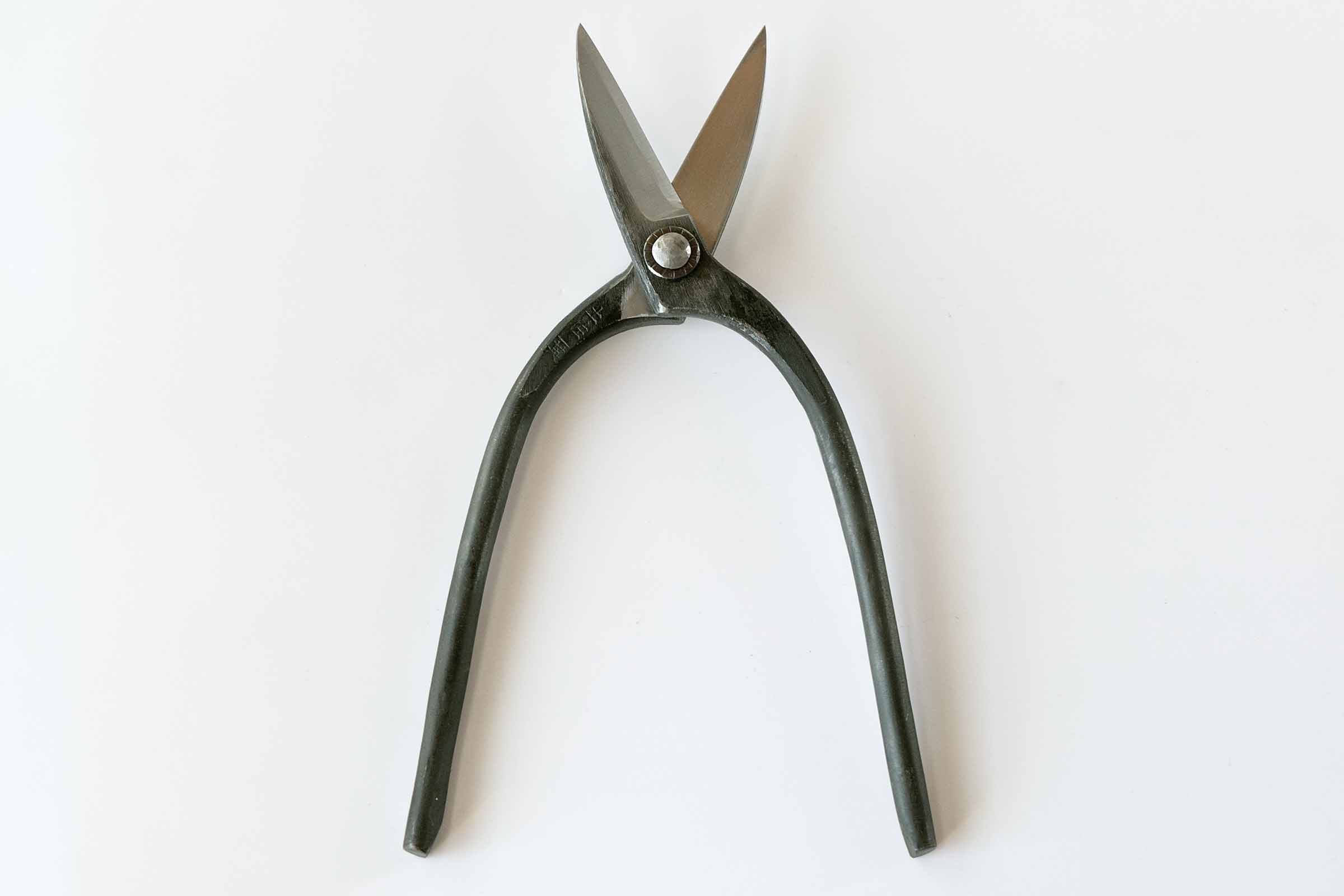
植木鋏 切箸(笹岡鋏製作所)。出典: 笹岡鋏製作所「はさみ屋」植木鋏 切箸

キリバシの全体。短く先のとがった刃、ねじで留めた要(かなめ)、輪のない2本の丸い柄
寸法の一例を挙げます。高知県いの町の笹岡鋏製作所は、切箸を刃長72mm、全長180〜270mmの7つの大きさで作っています。販売店の説明によると、佐保の植木用切箸 8寸は、全長248mm、刃渡り79mm、柄の部分が160mmで、重さは279gです。どちらも刃の長さは全長の3分の1ほどで、残りが柄です。

開いたキリバシ。柄がU字に広がり、2枚の刃が開く。ばねは無い
植木鋏・剪定鋏との違い
庭師が腰に差す鋏には、ほかに植木鋏と剪定鋏があります。植木鋏は大きな輪の柄に指を通し、剪定鋏は持ち手のばねで刃が開きます。キリバシには、そのどちらもありません。手の中で柄を開け閉めし、刃の合わせも自分の手で作ります。
| 項目 | 植木鋏 | キリバシ(切箸) | 剪定鋏 |
|---|---|---|---|
| 柄 | 大きな輪の形 | 輪のない2本の丸い棒 | 握りやすい形の持ち手 |
| ばね | 無い | 無い | 有る |
| 開け方 | 輪に掛けた指で開く | 柄の間に入れた小指で押し開く | ばねで開く |
| 刃 | 短く幅がある | 短く先がとがる | 半月形の切り刃と三日月形の受け刃 |
| 得意な仕事 | 込んだ小枝を1本ずつ | 枝先の仕上げ、松・マキの手入れ | 硬い枝 |
出典: 植木鋏と剪定鋏の形は連載9回目、キリバシの形は笹岡鋏製作所と販売店の商品写真、開け方と得意な仕事は当社の現場での使い方

植木鋏(左)、キリバシ(中)、剪定鋏(右)。柄の形と、ばねの有無が違う
同業の方の記録には、地域の違いも残っています。京都で修業した埼玉県の造園会社の代表は、関東の職人は植木鋏(蕨手〈わらびで〉)を常に腰に下げている一方、京都では剪定鋏と鋸だけで仕事をし、こだわる人はキリバシと鋸だけで仕事をする、とブログに書いています。
名前の歴史──「切箸」は金物の職人の言葉だった
「キリバシ」という名前は、植木の世界より先に、金物の職人の言葉として記録に出てきます。江戸時代の随筆『嬉遊笑覧』(1830年)には、「今かなものの匠は唐剪刀の如きものをきりばしといへり」とあります。辞典は、この「切箸」を、薄い金属の板を切る鋏と説明しています。今も千葉県館山市で作られる金切鋏(かなきりばさみ)は、別名を切箸といいます。
「箸」の字にも、鍛冶の道具の名残があります。鍛冶が焼けた鉄を挟んで扱う道具は「金箸(かなはし)」と呼ばれ、日本大百科全書は、「鋏」という字ももとは鍛冶の「かなはし」を指したと書いています。「はし」は、ものを挟む道具の呼び名でした。
日本の鋏の歴史を、辞典の記述から並べると次のとおりです。
| 時代 | 出来事 |
|---|---|
| 7世紀 | 奈良県の珠城山古墳から出土した鋏が、日本で最も古いものとされ、支点が根元にある握り鋏の型 |
| 奈良時代 | 正倉院の金銅剪子(こんどうのせんし)は、支点が中ほどにある型で、中国の唐の時代に現れた形 |
| 1579年 | 『言経卿記』に「木鋏」の語(庭木の鋏の早い記録) |
| 江戸時代初め | 徳川家康の遺品の記録に、U字の握り鋏を「日本ばさみ」と書く |
| 1692年 | 『諸国買物調法記』に京都の小刀・鋏の鍛冶 |
| 江戸時代後期 | 播州・越後・美濃・越前などで、鋏づくりが専門の仕事になる |
| 1830年 | 『嬉遊笑覧』に、金物の職人の「きりばし」 |
| 明治時代 | ヨーロッパで生まれた剪定鋏が日本に伝わる |
出典: 日本大百科全書「鋏」、改訂新版 世界大百科事典「鋏」、精選版 日本国語大辞典「木鋏」「切箸」(いずれもコトバンク)、株式会社アルスコーポレーション「剪定ばさみの選び方」

支点が根元にある握り鋏(左)と、支点が中ほどにある鋏(右)。キリバシは右の仲間
キリバシは、支点が中ほどにある鋏の仲間です。ただ、植木のキリバシが、金物を切る切箸と同じ流れから生まれたのか、形が似ているので同じ名で呼ばれるようになったのか、それを示す記録は見つけられませんでした。私の感覚では、輪の無い2本の柄で枝を挟む姿は、たしかに箸を使う手つきに似ています。
持ち方と、要(かなめ)の「隙間」
キリバシは、手に取ってすぐに切れる鋏ではありません。私の持ち方は、片方の柄を親指の付け根の手のひらに当て、もう片方の柄を人差し指から薬指で握り、小指を2本の柄の間に入れます。握れば刃が閉じ、小指で押せば刃が開きます。

キリバシの持ち方。片方の柄を親指の付け根に当て、もう片方を人差し指から薬指で握り、小指を柄の間に入れる

小指で柄を押し開く。ばねが無いので、開くのも自分の指
もう一つの難しさが、要の作りです。同業の方の記録によると、ふつうの鋏は要が隙間なく締まっていて、握るだけで2枚の刃がかみ合いますが、キリバシは要にわずかな隙間があります。握る力の入れ方で2枚の刃を横へ寄せ合わせ、刃先まで合わせて切ります。この加減が手に入ると、刃先まで軽く切れるようになります。

要の拡大。わずかな隙間があり、握る力の入れ方で2枚の刃を寄せ合わせる
職人の間では、キリバシを使えるようになるまで2年はかかるといわれます。ティッシュペーパーを切れるようになれば一人前の目安、という言い方もあります。私も修業時代、思うように切れるまでには時間がかかりました。買ったその日からよく切れる鋏が多い中で、手が覚えるまで待たなければならない、珍しい鋏です。
キリバシが生きる仕事──枝先の仕上げと松
私がキリバシを使うのは、主に3つの場面です。1つ目は、透かしの最後に込んだ小枝を1本ずつ切る、枝先の仕上げ。2つ目は、松やマキのように芽の細かい木の手入れ。3つ目は、花の後の手入れや小さな庭木です。どれも、葉や枝が込んだ所に刃先を差し込み、残す枝に触れずに狙った1本だけを切る仕事です。

込んだ枝先に刃先を差し込み、狙った1本だけを切る
刃が短く先がとがっているので、細い刃先が枝のすき間に入ります。キリバシを選ぶ理由は、この刃先の細さにあります。

仕立てた松の枝先を、キリバシで手入れする
反対に、太く硬い枝はキリバシの仕事ではありません。笹岡鋏製作所は、刃物を左右にこじると欠ける原因になると注意しています。当社の現場では、硬い枝は剪定鋏に、さらに太い枝は鋸に持ち替えます。松の冬の手入れは松のもみあげで書いています。
手入れと、鍛冶の手仕事
キリバシの多くは、鍛冶が一丁ずつ火で鍛えて作る鋏です。笹岡鋏製作所は1970年の創業で、大阪・堺の鋏鍛冶で技術を習い、土佐打刃物の自由鍛造という技術で手打ちをしています。佐保の切箸は、軟鉄と白紙鋼を鍛接した火造りの鋏と説明されています。
手入れの基本は、ほかの植木鋏と同じです。使った後は汚れや木のヤニを拭き取り、油を引き、要のねじにも油をさします。販売店は、刃の裏は研がないよう注意しています。研ぐと切れなくなるためです。
手が覚えるまで時間のかかる鋏ですが、私は修業時代から、枝先の仕上げと松の手入れにはこの鋏を腰に差してきました。私にとってキリバシは、枝先の1本を選んで切るという、日本の剪定の考え方をいちばん近くで支えてくれる鋏です。
海外の鋏との違い──海外の読者へ
英語圏の庭仕事の資料が勧める手の鋏は、ばねで開くバイパス式の剪定鋏(hand pruners)が中心です。輪もばねも無い柄で、細い刃先を枝のすき間に入れるキリバシにあたる園芸の道具は、私の知る限り英語圏には見当たりません。形が近いのは、むしろ板金を切る金切鋏(tin snips)です。日本語では、その金切鋏の別名も切箸です。
日本の剪定は、枝先の1本を選んで抜くことで樹形を整えます(透かし剪定)。私の考えでは、キリバシはその仕事のために、刃先の細さを第一に作られてきた鋏です。
よくある質問(Q&A)
Q1. キリバシ(切箸)とは何ですか?
A. 柄に指を通す輪が無く、2本の丸い棒のような柄で握る植木鋏です。刃は短く先がとがり、ばねはありません。込んだ枝先や松の手入れで、狙った1本を切るのに使います。
Q2. キリバシと植木鋏(蕨手)は、何が違いますか?
A. 植木鋏は大きな輪の柄に指を通して開け閉めしますが、キリバシの柄には輪がありません。手のひらと指で柄を握り、柄の間に入れた小指で押し開きます。どちらも、ばねはありません。
Q3. 「切箸」という名前の由来は何ですか?
A. 江戸時代の随筆『嬉遊笑覧』(1830年)に、金物の職人が鋏を「きりばし」と呼んだ記録があり、今も金切鋏の別名です。鍛冶がものを挟む道具は「金箸(かなはし)」と呼ばれました。植木のキリバシとのつながりを示す記録は見つかっていません。
Q4. キリバシは、すぐに使えるようになりますか?
A. 職人の間では、使えるようになるまで2年はかかるといわれます。要にわずかな隙間があり、握る力の入れ方で2枚の刃を寄せ合わせて切るためです。ティッシュペーパーを切れるようになることが、慣れた目安とされます。
Q5. キリバシで太い枝を切ってもよいですか?
A. 向いていません。刃をこじると欠ける原因になります。キリバシは枝先の細い枝に使い、硬い枝は剪定鋏、さらに太い枝は鋸に持ち替えます。
マンション・施設・行政のご担当者様へ
当社は、年間の植栽管理、樹木診断、高木の剪定・特殊伐採を承っています。管理の進め方や診断の流れは、資料ダウンロードのページでご覧いただけます。ご相談はお問い合わせフォームからお待ちしています。
出典・参考情報
・精選版 日本国語大辞典「切箸」(『嬉遊笑覧』1830年の用例)、事典 日本の地域ブランド・名産品「切箸」(金切鋏の別名、千葉県館山市)
・精選版 日本国語大辞典・デジタル大辞泉「金箸」(鍛冶がものを挟む道具)
・日本大百科全書(ニッポニカ)、改訂新版 世界大百科事典「鋏」(日本の鋏の歴史、「鋏」の字と「かなはし」)
・精選版 日本国語大辞典「木鋏」(『言経卿記』1579年の用例)
・笹岡鋏製作所「植木鋏 切箸」「はさみ屋」(寸法・鋼材・使用上の注意、創業と製法)
・刃物・道具の専門店ほんまもん「佐保 植木用 切箸 8寸」(寸法・重さ・製法・手入れ)
・株式会社アルスコーポレーション「剪定ばさみの選び方」(剪定鋏の由来)
・株式会社造園あら井 アライタカシ「造園屋さんの道具集 〜鋏〜」(2015年12月17日。京都と関東の鋏の違い)
・play green 庭師 タケシ「切箸を使い始めて…」(2014年3月20日。要の隙間、習熟の目安)
関連記事
・植木鋏と剪定鋏の使い分け──2つの鋏の形と役割、切り口を守る刃の向き|樹木医が図解
・刈込鋏の使い方──刃の動かし方と刈込の考え方
・松のもみあげ──古い葉を手でむしる冬の手入れ
・透かし剪定とは──日本の庭師が「抜いて整える」剪定の考え方
・剪定の切る位置はブランチカラー
・飛庄(飛塚製鋏所)の剪定鋏──山形の工房を樹木医が訪問
株式会社トシ・ランドスケープ
樹木医 中村雅俊
English: Kiribashi — Japanese Garden Shears Without Rings, Their History and Features
Kiribashi are Japanese garden shears with two plain, rod-like handles and short, pointed blades. With no spring and no finger rings, they take time to master, yet craftsmen have kept using them to cut one chosen twig among crowded tips and in pine work. A Jumokui (tree doctor) explains the history of the name, the shape and how to hold them, with illustrations.
This is a special edition of our series on the pruning techniques of Japanese gardeners (niwashi and uekiya). The ninth article covered ueki-basami and sentei-basami. As a sequel, this one takes up one more pair of shears: the kiribashi I have carried at my hip since my apprenticeship.
What are kiribashi?
Kiribashi are garden shears with no finger rings: you grip two round, rod-like handles. The name is written 切箸, literally “cutting chopsticks”. The blades are short and pointed, and the handles are about twice as long as the blades. There is no spring. Closed, the ends of the two handles meet and the tool forms a long teardrop.
Kiribashi by Sasaoka Hasami Seisakusho. Source: Sasaoka Hasami Seisakusho, Hasamiya, “Ueki-basami Kiribashi”
Kiribashi: short pointed blades, a pivot fastened with a screw, and two round handles without rings.
As examples of size, Sasaoka Hasami Seisakusho in Ino, Kochi Prefecture, makes kiribashi with a 72 mm blade in seven sizes from 180 to 270 mm overall. A retailer lists the Saho 8-sun kiribashi at 248 mm overall, with a 79 mm blade, a 160 mm handle section and a weight of 279 g. In both, the blade is about a third of the length; the rest is handle.
Kiribashi opened. The handles spread into a U and the blades open. There is no spring.
How they differ from ueki-basami and sentei-basami
Japanese gardeners also carry ueki-basami and sentei-basami. Ueki-basami have large ring handles for the fingers, and sentei-basami open by a spring. Kiribashi have neither. You open and close the handles within your hand, and you make the meeting of the blades with your own hand.
| Item | Ueki-basami | Kiribashi | Sentei-basami |
|---|---|---|---|
| Handles | Large rings | Two round rods without rings | Shaped grips |
| Spring | None | None | Yes |
| Opening | Fingers in the rings | Little finger between the handles pushes them apart | The spring |
| Blades | Short and broad | Short and pointed | Half-moon cutting blade and crescent hook blade |
| Best for | Crowded twigs, one at a time | Finishing branch tips, pine and podocarpus work | Harder branches |
Sources: shapes of ueki-basami and sentei-basami from the ninth article of this series; shape of kiribashi from product photos by Sasaoka Hasami Seisakusho and a retailer; opening and best uses from our own work.
Ueki-basami (left), kiribashi (center) and sentei-basami (right). The handles differ, and only sentei-basami have a spring.
A fellow gardener has recorded a regional difference. The head of a landscaping company in Saitama Prefecture, who trained in Kyoto, writes on his blog that craftsmen in the Kanto region always carry ueki-basami (warabide) at the hip, while in Kyoto they work with sentei-basami and a saw, and those who are particular work with only kiribashi and a saw.
The history of the name: kiribashi began as a metalworkers’ word
The word kiribashi appears in records as a metalworkers’ term before it appears in gardening. The Edo-period essay collection Kiyū Shōran (1830) notes that metal craftsmen of the day called a thing like Chinese scissors “kiribashi”. Dictionaries explain this kiribashi as shears for cutting thin sheet metal. The kanakiri-basami (tin snips) still made in Tateyama, Chiba Prefecture, are also called kiribashi.
The character for “chopsticks” also carries a trace of the forge. The tongs a smith uses to hold hot iron were called kanahashi, and the Nipponica encyclopedia notes that the character for scissors originally referred to the smith’s kanahashi. “Hashi” was a name for a tool that grips.
Arranged from the dictionaries, the history of Japanese scissors runs as follows.
| Period | Event |
|---|---|
| 7th century | Scissors excavated from the Tamakiyama Kofun in Nara are considered the oldest in Japan: a grip-scissors type with the pivot at the base |
| Nara period | The gilt-bronze scissors in the Shōsōin have the pivot in the middle, a form that appeared in Tang China |
| 1579 | The word kibasami (tree shears) appears in the diary Tokitsune-kyō-ki, an early record of shears for garden trees |
| Early Edo period | The record of Tokugawa Ieyasu’s possessions calls U-shaped grip scissors “Japanese scissors” |
| 1692 | Shokoku Kaimono Chōhōki lists the knife and scissors smiths of Kyoto |
| Late Edo period | Scissor making becomes a specialist trade in Banshū, Echigo, Mino, Echizen and elsewhere |
| 1830 | Kiyū Shōran records the metalworkers’ “kiribashi” |
| Meiji period | Secateurs, born in Europe, reach Japan |
Sources: Nipponica, “Hasami”; Heibonsha World Encyclopedia, “Hasami”; Nihon Kokugo Daijiten, “Kibasami” and “Kiribashi” (all via Kotobank); ARS Corporation, How to Choose Pruning Shears.
Grip scissors with the pivot at the base (left) and shears with the pivot in the middle (right). Kiribashi belong to the latter.
Kiribashi belong to the family of shears with the pivot in the middle. I could not, however, find any record showing whether garden kiribashi grew from the same line as the metal-cutting kiribashi, or simply came to share the name because the shape is similar. To my eye, the way two ringless handles grip a branch does resemble a hand using chopsticks.
How to hold them, and the “gap” at the pivot
Kiribashi are not shears that cut well the moment you pick them up. I hold them with one handle against the palm at the base of the thumb, the other wrapped by the index to ring fingers, and the little finger between the two handles. Squeezing closes the blades; pushing with the little finger opens them.
Holding kiribashi: one handle against the base of the thumb, the other in the index to ring fingers, the little finger between the handles.
The little finger pushes the handles open. With no spring, opening is also the work of your own finger.
The other difficulty is the pivot. As a fellow gardener has recorded, ordinary shears have a pivot closed without play, so the blades meet as soon as you squeeze; kiribashi have a slight gap at the pivot. By the way you apply grip, you press the two blades sideways against each other and bring them together right to the tip. Once your hand learns this, the shears cut lightly to the very tip.
The pivot, enlarged. There is a slight gap, and the way you grip presses the two blades together.
Among Japanese gardeners it is said that it takes two years before you can use kiribashi. Another saying holds that being able to cut a tissue is the sign you have got the hang of it. In my own apprenticeship, too, it took time before they cut as I wanted. Most shears cut well from the day you buy them; these are rare shears that make you wait until your hand has learned them.
Where kiribashi come into their own: finishing branch tips and pines
I use kiribashi mainly in three situations. First, finishing branch tips, cutting crowded twigs one at a time at the end of sukashi (thinning). Second, work on trees with fine buds such as pines and podocarpus. Third, tidying after flowering and work on small garden trees. In each case the job is to slip the tip into crowded leaves and twigs and cut only the one you intend, without touching the branches you keep.
Slipping the tip into crowded branch tips to cut only the chosen twig.
Because the blades are short and pointed, the narrow tip fits into gaps between twigs. That narrow tip is the reason to choose kiribashi.
Tending the branch tips of a trained pine with kiribashi.
Thick, hard branches, on the other hand, are not work for kiribashi. Sasaoka Hasami Seisakusho warns that twisting the blades from side to side can chip them. In our work we change to sentei-basami for hard branches and to a saw for thicker ones. Winter work on pines is covered in momiage on pines.
Care, and the work of the smith
Most kiribashi are forged one at a time by a smith. Sasaoka Hasami Seisakusho was founded in 1970; its founder learned the craft from scissor smiths in Sakai, Osaka, and forges by hand using jiyū tanzō (free forging), the technique of Tosa uchihamono (Tosa forged blades). The Saho kiribashi are described as fire-forged shears with white paper steel forge-welded to soft iron.
Care is the same as for other garden shears. After use, wipe off dirt and sap, oil the blades, and oil the pivot screw. A retailer warns not to sharpen the back of the blade, as that stops it cutting.
They take time for the hand to learn, but since my apprenticeship I have carried them at my hip for finishing branch tips and for pine work. For me, kiribashi are the shears that stand closest to the Japanese way of pruning: choosing one twig at a branch tip and cutting it.
How they compare with shears abroad — for readers outside Japan
The hand shears recommended in English-language gardening guides are mainly bypass hand pruners that open by a spring. As far as I know, there is no garden tool in the English-speaking world that matches kiribashi, with ringless, springless handles and a narrow tip that slips between twigs. The closest in shape are in fact tin snips, which cut sheet metal; and in Japanese, another name for tin snips is kiribashi.
Japanese pruning shapes a tree by choosing and removing single twigs at the branch tips (sukashi pruning). In my view, kiribashi are shears made for that work, with the fineness of the tip put first.
Frequently Asked Questions (Q&A)
Q1. What are kiribashi?
A. Garden shears with no finger rings, held by two round, rod-like handles. The blades are short and pointed, and there is no spring. They are used to cut one chosen twig among crowded branch tips and in pine work.
Q2. How do kiribashi differ from ueki-basami (warabide)?
A. Ueki-basami are opened and closed with the fingers in large ring handles; kiribashi have no rings. You grip the handles with the palm and fingers and push them open with the little finger placed between them. Neither has a spring.
Q3. Where does the name kiribashi come from?
A. The Edo-period essay collection Kiyū Shōran (1830) records metal craftsmen calling shears “kiribashi”, and it is still another name for tin snips. The tongs a smith uses to grip things were called kanahashi. No record has been found linking these to garden kiribashi.
Q4. Can you use kiribashi straight away?
A. Among Japanese gardeners it is said to take two years. There is a slight gap at the pivot, and you cut by pressing the two blades together through the way you grip. Being able to cut a tissue is taken as the sign you have got used to them.
Q5. Can kiribashi cut thick branches?
A. They are not suited to it. Twisting the blades can chip them. Use kiribashi on thin branch tips, change to sentei-basami for hard branches and to a saw for thicker ones.
Sources
– Nihon Kokugo Daijiten, “Kiribashi” (example from Kiyū Shōran, 1830); Encyclopedia of Japanese Regional Brands, “Kiribashi”.
– Nihon Kokugo Daijiten and Daijisen, “Kanahashi”.
– Nipponica and Heibonsha World Encyclopedia, “Hasami”.
– Nihon Kokugo Daijiten, “Kibasami” (example from Tokitsune-kyō-ki, 1579).
– Sasaoka Hasami Seisakusho, Hasamiya: “Ueki-basami Kiribashi” and company information (Japanese).
– Honmamon: “Saho Kiribashi for Garden Trees, 8 sun” (Japanese).
– ARS Corporation. How to Choose Pruning Shears (Japanese).
– Zoen Arai, Takashi Arai. “Tools of the Landscaper: Shears” (blog, 17 December 2015, Japanese).
– play green, Takeshi. “Starting to Use Kiribashi” (blog, 20 March 2014, Japanese).
Masatoshi Nakamura
Jumokui (Tree Doctor), Toshi Landscape Co., Ltd., Tokyo
連載「日本の剪定技術」のすべての回は、連載の一覧からご覧いただけます。


